Wednesday, June 22, 2011
Wonder Woman, Christina Hendricks and the Womanly Body
Maybe it's just my recent stint on Pavarti K. Tyler's (nee Devi) 'blog, but lately I've been mulling over some of my opinions on more risque subjects. (Well, more risque than normally occupy this particular space, anyway.) Today I found a couple of items that reminded me of one of these long-held opinions. The first such item had to do with Christina Hendricks' long-held desire (longevity at least in Internet scale) to play Wonder Woman, and her Drive director Nicolas Refn's claim that not only was he interested in bringing that particular character to the big screen, but that Hendricks would be his...er...woman. The second had to do with Refn's particular take on the character and her world, insofar as he's dreamed it up.
These public discussions about Hollywood casting rarely yield results, even when they're held after the movie deal has already been picked up, much less so when every single person involved in the conversation is speaking hypothetically. Now, too, studios are banking way too many dollars on their superhero franchises to leave decisions about casting to people standing so far from the board room. Case in point: Donald Glover for Spider-Man. An amazing groundswell of support (though, too, controversy) responded to the suggestion he play Spidey for the reboot, and that sure didn't work out. So I'm not banking on a Hendricks/Refn Hellenic team-up any time soon.
What the possibility does raise is a couple of issues I'd like to address.
The first is the as-yet-unspoken gimmick of one of the few lauded curvy celebrities playing a superhero who is also - let's face it - a sex symbol. (And feminist symbol; and if you don't believe me, do a web search for "William Moulton Marston" and "wonder+woman+bondage." [With safe-search activated {Of course.}.]) Christina Hendricks has somehow tread a brilliantly slender line in her career, being both of ample figure and widely regarded as sexy (and in some [these] circles, to "sexy," please append "as all hell"). And lest we forget, a damn fine actor, regardless. So we can say Ms. Hendricks would be an unconventional choice for the Woman, yet a potentially popular one. Sex sells in Hollywood.
Detractors would complain that she isn't hot enough, or that she's fat. Neither is the case, by a long shot. Would-be supporters might argue that of course she's sexy - just look at that bust. To whom I must respond, of course that doesn't hurt (not in a bad way, anyway) but if you think that's why she's beautiful, you're missing it by a-mile-and-a-half. And finally, some really, truly, well-intentioned fanboys might cry that she has the nerd pedigree for her Firefly connection, and that with a dye job and some sit-ups they will welcome her with loving arms. Add to that a few of us who might even feel a little earned self-righteousness from endorsing a full-figured super-heroine. I am no better than these hypothetical people, but all of these miss the point when it comes to Hendricks as a good choice for Wonder Woman's boots.
Christina Hendricks would be a brilliant Wonder Woman (particularly if paired with a director with real ingenuity, like Refn) because she understands all the complexity involved in and strength needed for navigating life as a determined woman with a powerful - not to mention inescapable - sexual identity. Not only has she had to see past the limitations of others' assumptions, but she's succeeded in being associated with good work that she presumably has a personal appreciation for. In some ways, this is a scenario in which any woman finds herself, in some way and on a daily basis. I just happen to think Hendricks is well-qualified to portray that fight with unique grace and sensitivity.
Issue the second that this brings up for me is perhaps a less socially significant one; yet more important personally (I'm somewhat ashamed to admit). It also brings up a criteria that might put my dear Ms. Hendricks to the test, in a way.
Women who work wear muscle.
Look, I'm not a body-building fetishist, any more than girls who lust after brawny Hollywood hunks are. Taken to extremes, muscle mass is often freakish and Geiger-esque. The trouble is, ideas of contemporary beauty seem to limit us from finding any developed musculature on women appetizing. What is that? And why must it be used as an excuse for me to suffer through another fight scene such as this:
I mean: really.
The bad examples are too numerous to relate, and I can only think of a few positive ones; among them, Terminator 2 and G.I. Jane. T2 is of course well known for how impressive a transformation Linda Hamilton made. In particular, she went from making an especially soft impression in 1984 to a very lean and angular one. I don't mean to detract from that at all - it was impressive - but I also have images of Ms. Hamilton spending quite a bit more time on aerobics than anyone in her character's situation likely would. To wit: still an emphasis on weight loss. G.I. Jane's Demi Moore did quite a shade better, daring to wear biceps and actually demonstrating her strength on film.
These examples remain in the minority, however. Most Hollywood images of powerful heroines still favor slinky dresses and long legs over developed shoulders. Sometimes this leaner physical type is handled better than others. Smart fight choreographers put such nimble minxes in fights in which they get to move fast and use lots of kicks and lower-body advantage (real advantage, rather than the fetishistic "leg lock" depicted in the video above), and intelligent directors offer plot-related explanations for ballet-bodied ladies putting the smack down on crews of mercenaries.
But please to be noting, if you will, the distinction between the way the admittedly wonderful Summer Glau looks, and the way a woman (Bridget Riley) who spends her days actually working on fighting does:
(To her enormous credit, Glau does manage that scorpion kick much better than Riley.)
I know movies are not reality, and that men don't always rise to similar challenges, either (it would seem the Internet hasn't favored us with a capture of Kilmer's shirtless scene in Batman Forever). In recent years, however, Hollywood has held to a truer physical standard for their male superheroes, and I'd like to see a little courage in applying those standards to Wonder Woman, whenever she finally appears. Some may argue that women don't put on mass in the same way most men do, and this is the where the topic really does get a little personal for me.
They do. They so do. It may not always read the same on women, but hard work = muscles. I have had the pleasure of working with female circus performers off and on during my acting career, and in particular in the past two years as I've studied aerial silks I've gotten to see women physically transform over the course of time. I can say with absolute confidence that when a women practices pulling herself up a few yards of fabric once a week for a month or two, not only do her arms get more defined, they grow larger muscles. Girls have guns, gang. Respect.
That's it. In sum: Christina Hendricks, with some push-ups, as Wonder Woman: Yes. The larger issue is that I believe the predominant opinion of feminine beauty pretty much sucks. My two little opinions above don't even begin to cover it, of course. Plus they address my personal preferences just as much as Hollywood's bias, I suppose. That's all completely subjective, but I know female fighters have real arms, and nobody in this lifetime's going to convince me Christina Hendricks is less than beautiful or talented. But I pretty much expect the accusations of personal taste to start rolling in, so...hang on...lemme just get my latest issue of Guns & Curves in hand so I can read it (for the articles) at my leisure as the flame-war commences (I should be so lucky, to have such readership)...
Tuesday, May 24, 2011
Guest Post @ Devi Pavarti
I have a dear friend with a 'blog all her own who has been accepting guest submissions lately, and I'm honored to have had mine published there today. Please go send her traffic, whether you read my article or not. And Fair Warning: in my article there resides a terrible, shameless pun.Somewhat in deference to her interests, the piece I wrote is a musing on the definition of erotica as it applies to literature. Pavarti has been a tremendous supporter of my fiction writing (tough love though it may be, as you'll see from her introduction) and I wanted to contribute something I was not only interested in, but something to which her readers might have some response. Perhaps Unfair Warning: Pavarti doesn't censor the eroticism from her 'blog so, though my article is itself harmless, don't go browsin' unless you're ready to be a little titillated...
Tuesday, May 17, 2011
Spring Flu = Movie Time
![]() |
| Postcard design by Megan Heflin. |
I am a man of many talents, not the least of which is sudden, debilitating illness at irregular yet strangely predictable intervals. I never imagined I would have a show crash (sudden collapse of health and mental faculty following a production's close; not to be confused with Snow Crash) after filming Android Insurrection, yet that seems to be exactly what has happened to me over the past four days or so. How else can I explain a sudden flu in the middle of spring? It even began during a lull in the almost-constant rain we're having. It began, in fact, while I was enjoying an impromptu trip out Thursday night to see Thor.
I don't know, man. It's enjoyable? It's enjoyable. They did a nice job capturing some of that easy humor that made the first Iron Man so palatable, without skimping on serious stakes for the characters. Branagh was in familiar territory in many respects, including regally set father-son relationships. I also found it largely forgettable, though. Probably the most interesting aspect of it was how finely honed Loki's character seemed to be - never being outright evil, never being altogether good. I actually found myself wondering how much he himself was aware of his motivations, at times. Unexpected complexity for this kind of movie.
It's also, unsurprisingly, a movie that cluster-flocks your eyeballs with elaborate CGI. They seemed aware enough of this to make the Earth setting very plain and grounded, but that doesn't help me view Asgard as any less of a carnival of RoyG.Biv-brought pain, a little vacation in a rainbow-decked uncanny valley, a . . . really computer-generated picture-thing. And I really do wish someone would get a memo out to Marvel that this rubber-ized "armor" material they use doesn't read as magi-science metal. It reads as cheese, a la '90's The Flash television series. At one point in the movie, Thor drops one of their shields, and the pick-up of it hitting the ground uses an actual metal shield. It was so jarring to the continuity to me I laughed. Why did no one else? The prop had clearly been made of plastic up until that point! HA HA!
But to some extent, I have to admit, I was probably just disappointed in a similar way to how I was over Batman Begins. It's not that they did an especially bad job, it's just not the movie I would've liked to see. I know it would have made some problems for integrating Thor into the Avengers movie, but I think when life hands you a superhero who is a god, nested in ancient history, you have the potential to do something really different with the idiom. Make him more of a question mark. Dress him in rusty metal, or dare to give him religious overtones. Just a little grit and ambiguity is what makes me more interested in Captain America and X-Men: First Class than Thor. But I may be alone in this, and gods know it wasn't my $150 million, so what do I know?
The rest of my weekend enjoyed the remainder of our "three months free" Showtime (the WORST pay channel?), The Movie Channel and Netflix Instant. (Wife Megan can rejoice that at least a couple of the decidedly unromantic Korean films have been wiped from our queue.) I started out inauspiciously, which may or may not have had something to do with how sick I was compared to how sick I thought I was - by midday my fever of which I had previously been unaware had spiked to 102. I wrapped up Valkyrie On Demand (oh Bryan, what pretty, inconsequential movies you make) and started on Adventureland. I only got about fifteen minutes in to that before giving up. Still can't decide if that was because I found the movie improbably uninteresting (it is) or because my frustration trying to understand Jesse Eisenberg's meteoric movie career hit a bursting point (it did).
But THEN. Oh, THEN. Cruising through channels for something short-term, I found that Big Fan was just starting. This is a little movie I've had some curiosity about. I enjoy it - succeed or fail - when comedians (Patton Oswalt, in this case) tackle serious fare, and I thought the movie sounded like it had potential for interesting conflict when I heard about it a couple of years ago. But I pretty much hate spectator sports (subject for another post) and, frankly, at the time I was a little mixed on Patton. Since then I've had time to learn more about him, and he's grown on me. So I gave Big Fan a shot.
OH MY GOSH YOU GUYS. Oh my gosh. So good. So GOOD. Man. This movie was surprising in all the best ways, primarily because it is deftly handled with incredible honesty. It's ugly - New York and Jersey look like they really do most of the time, and the people are presented in all their fat and crinkles. It's beautiful - so believable, and the most despicable of characters are played with real heart. And what everyone said about Oswalt's performance is true. It's unequivocally wonderful. I think it's entered my canon of great NYC movies, in spite of being contemporary, largely in New Jersey and about football fans. Go to see (er, at home, from whichever delivery service).
After Big Fan, I shuffled back to bed with my peaking fever, and brought the laptop to consume one that I've been hanging on to for far too long. I balked at Let the Right One In; don't know why, but I just keep putting that one off. Instead, I finally hunkered down for Oldboy. Which, I've decided, was a mistake. 1) I waited too long and it got built up quite a bit in my mind 2) Big Fan left me high, not in the mood for hard-boiled noir 3) I've since learned the dubbing on Old Boy is atrocious, and I should've gotten the DVD and watched with subtitles. It's a good film. It's based on manga, and is a revenge story, so . . . BRING THE KIDS! (But don't, at all.) Ugh. That was my overall response. It's difficult to imagine a Spielberg/Smith remake.
But it was awfully well done! With both (dark) humor and good performances! Yay, noir, as well! And one thing, which I can't believe I never heard specifically about: corridor fight scene. Oh my God. Shot over three days with no cuts or CGI edits (barring some small CGI to deal with a stabbing and a few punch connections). All time - it's in my top ten fight scenes, indubitably. Warning: This is violent: No, really:
I didn't feel like leaving Korea just yet (in spite of having a bit of a gorge in my throat [possibly a live octopus]) and ventured thereafter into The Host. This is a movie I can recommend without hesitation. Unless you dislike monster and/or dysfunctional-family movies. It's billed as a horror movie, but I think that's a little reductive. What gives the movie wings (gills?) is its success in portraying a lovable yet serious dysfunction in family, society - really in humanity at large. The struggle against the monster becomes the struggle against our own nature, and its outcome is satisfyingly bleak. That being said, the movie is still very funny and ends on a hopeful note. Great sick viewing. Wish I could have seen it with a NYC audience when it was in theatres.
I tried to move on to Daybreakers which - I've been led to believe - is a largely underrated movie, but alas the weight of sleep was too much. The good Wife and I did finally consume I Love You, Phillip Morris over the course of Saturday into Sunday, which had been laying listless on our sidetable for almost a week. ILYPM is really REALLY good. I think. I was a little fever-hazy, feeling helpless for much of it, so I might have been especially emotionally pliable. But I think it was really REALLY good. A pretty impressive blend of humor, style, and genuine emotion. Great performances from two actors who are, admittedly, favorites of mine (though certainly far from do-no-wrong status). I wanted to stand up and clap for them at the end, but that may speak to my physical state as much as to their work.
There's also a lot of outright male homosexual sexuality. Men, having sex with each other, and enjoying that. So it may not be everyone's thing. I, for one, found its approach to that aspect refreshing. It pulled no punches, while also having a freeing sense of humor about it. Frankly, I expected to experience more of a challenge with it, given how much seeming controversy surrounded the movie's release here in the US. I wonder if that controversy was more constructed to try to market the film post-Brokeback, or if anti-homosexual contingents are more offended by enjoying homosexuality than by glorifying or being coy with it? Whatever. Movie's not about that - surprise, surprise.
Aptly enough, the weekend ended with both the Wife and I performing in our cinema-themed, student silks show: Coming Attractions. Each act was inspired by a different popular movie, Wifey's being an amazing (and impressively long) solo inspired by Eternal Sunshine of the Spotless Mind. I made it in by the skin of my constitution (and the grace of some OD'ing on Alka-Seltzer Cold'n'Flu) and managed to perform a little less than half of my Die Hard-inspired solo. I wasn't sure if I had recovered enough by Sunday evening to manage the opening move (an all-arm climb) much less anything else, but adrenaline is the best medicine, and in a way I had been studying movie magic my entire accidental three-day weekend. As I got close to my improvised stopping point, hanging from the ceiling by my knees and grappling with sweaty hands to tie a knot below me, I thought:
This is apt, too. John McClane would totally have the flu while having to do something both stupid and awesome. Yippee-ki-yay...
Monday, March 30, 2009
Burlesque

Last Saturday was the day of celebration for Wife Megan's 30th anniversary of the day of her birth and she, being the woman I married, wanted to go see some good, wholesome burlesque. You know burlesque, right? It's that quaint throw-back to a more innocent time, when men were men, women were women, and occasionally they all agreed to meet somewhere with dim lighting to reveal their knees to one another. One of the things I love about living in New York is being somewhere that such nostalgia for the frilly sins of the past exists. Any town that's a friend of anything remotely related to vaudeville and old-timey fun, is a friend of mine, as I always say (or will, henceforth). Furthermore, I specifically love burlesque. It's theatrical, it's joyous, and it usually incorporates lots of humor and props with its boobies. What's not to love?
So we went to The Slipper Room.
We stayed for many acts and several hours.
We left late, and they were still going strong.
Most of us will never be the same.
So from a theatrical perspective, it was a roaring success. I mean, if I can perform in something that really evidently changes people, I consider that a pretty big success. The specificity of that change is something that's even trickier than the change itself, given that all live performance is by its nature collaborative and interpretive. So personally, if you got something out of it, I got something out of it too. This reflects my attitudes on a lot of things. Like . . . dance. Or . . . board games. Or . . . other occupations of one's quest for joyous experiences. Let's not be judgmental about anyone's pursuit of happiness, even if they spell said pursuit "happyness." Hey: Rock on. It brings you joy and, on some level, that makes me happy.
Now there were some things I witnessed Saturday last that did not, per se, make me happy. The responses I had were more along the lines of being made to feel surprised, or confused, or scared. Very, very scared. But others really enjoyed some of these things, and no one got hurt or maligned beyond repair (though of course some audience mockery is part of the idiom), and so we can all look back on it and laugh. Sure, some of us may have gone home and gone directly into the shower, do not pass "GO!", do not bother removing one's clothing. But here we all are, scarless, and with a generally broader view of our fellow man, woman, and all others.
A broader view in a smaller world, I should say. I knew one of the performers -- had performed with her before, in fact. Her stage name is Miss Saturn, and she is a dynamite hula-hoop artist. She is also, it turns out, somewhat uninhibited in her display of God's gifts. When I performed alongside her, it was at a benefit for Friend Melissa's company, Kinesis Project. She hooped it up, I clowned around, and afterward she suggested we work together again some time, but I never followed up. Now I'm left to wonder if following up would have led me to The Slipper Room. It would not have been an entirely unwelcome opportunity, assuming I would have been able to stick to my personal preferences for the content of my act. During Saturday's experience I also had the unexpected mystery of feeling I recognized another performer: one "Harvest Moon." As it turns out, I don't. She's not who I mistook her for, but she has nevertheless reminded me that secret identities are as common in this city as free newspapers.
Some may view my appetite for nostalgia with disdain, but what can I say? I like sentimental sweetness in my indulgences, and could have used a bit more at The Slipper Room. After each break, the acts grew progressively more risque and shocking, and I grew less and less interested. Of course, if I were to run a contemporary burlesque show in New York City, I've no doubt I'd have to make similar allowances. After all, what we saw was probably closer in overall effect to us as the burlesques of old were during their time. These shows were shocking, titillating not just in sensual ways, but in visceral ones. The atmosphere should be one of reckless abandon and in this sense there was nothing inapt about my experience Saturday night. It was just that I had walked into a circa-1930s Berlin burlesque, when I had been hoping for a circa-1889s French one, I suppose. C'est la vie! I regret nothing!
Looking back, it occurs to me that there's an awfully fine line between anticipation and dread, and that line is going to be set at different places for different folks. A friend of mine recently sent me some writing research that discusses the role of feedback loops in sexual experiences. The gist of it was that "healthy" sexuality involves a feedback loop of increasing focus on arousal, and "unhealthy" (or perhaps, unhelpful) sexuality involves a neurotic, self-evaluative loop. Both increase the focus, but one allows you to engage, and the other rather prevents it. If we accept that sexual feelings are erotic in the broader sense, this is a very interesting way of looking at what we as performers inspire in our audiences. Will we fill them with eager anticipation, loathsome dread, or something of a different ratio altogether? In my opinion, neither is bad, just a different effect. And whatever effect, it begs the question: What, if anything, will we make the payoff?
Monday, December 22, 2008
Tropic of Gemini

Tuesday, February 12, 2008
Give Me My Props

- The straight man. In many instances, this is the default for prop comedy. After all, as much as you may get upset, the hairbrush will remain vigilantly a hairbrush. The funny thing is that, like a good straight man, a prop says more to the audience the less it does. It's key that the performer adhere to one of the most basic rules of good scenework: to make the scene partner look good. It's just that in this case, the scene partner is a supposedly inanimate object.
- The first love. There's a lot of mileage to be gotten out of approaching a prop as though it were something you've never, ever seen before. The stages of exploration tend to mirror a person's first notice of the opposite (or rather, the sexually attractive) sex. A whole range of emotions become involved here. While it may not be explicitly "falling in love," neither are a lot of love stories. Hate the thing, but hate it with curiosity, or inescapability. A common gag from this scenario is to use an object whose use is obvious to the audience, and determine another use for it altogether.
- The His-Girl-Friday. One object becomes useful in a variety of ways, conventional and unconventional. The trick here is to maintain a relationship with the prop. It's not enough to use a turkey baster to funnel oil, beat a gong and baste a turkey; this has to inspire gratitude or amazement or something changing in the performer. Otherwise, it quickly degenerates into Gallagherism. This relationship has the benefit of incoporating higher and higher stakes, as it is founded on need or necessity.
- The family member. Sometimes an object is so much a part of you that it pains you to be apart from it, much less see it suffer in any way. You may get frustrated with it, call it no good, etc., but the moment anyone else does you're there to say, "Hey! You can't talk to her like that!" This is a very familiar prop, usually worn on the person in some way. You know it like no one else does. Establish this relationship firmly enough, and you have one of the greatest toppers of your prop-comedy career: giving your prop away.
- The nemesis. For those more inclined toward positive relationships, this can also manifest as a sort of the worthy adversary, or even the buddy-cop, so long as there's plenty of head-butting. The relationship here is one of enmity, of occasional hatred and much strategy. The prop is against you at every turn, it's doing it on purpose, yet it is somehow allowed to continue to exist. Often times, this interplay requires a lot of technical trickery on the performer's part, engineering ways to be "attacked" by the object. However, it can be very simple, too. Refusing to move can be a confounding adversarial technique.
- The boss. It may at first be difficult to imagine an inanimate object as having higher status than a performer, but in all of these relationships status should be shifting as events unfold. A prop can be "the boss" if it's extremely valuable or a symbol of authority, like a crown, or simply if the performer recognizes that this prop has wants that must be fulfilled. In this relationship, the prop has the ability to punish or praise the performer, these actions being a matter of interpretation on the performer's part.
- The servant. Not quite as rich a terrain here, as objects are generally considered to be servants to us all anyway. There are, however, interesting facets of relationship to be explored when one considers the "clever servant" archetype, or the ways in which one tries to master people, as opposed to props.
And, of course, relationships change over time. These are not categories to singly adhere to, but forms to specify something more organic and unpredictable.
It may seem silly to some to create these sorts of relationships with objects. It occasionally seems that way to me, too, until I observe that these relationships already exist off-stage. Have you never seen a coworker assault his or her unruly stapler, or an older gentleman who caresses his cane as he sits? Theatre, in the all-encompassing sense, comes down to people coming together to have a good natter, and other people coming to watch it happen. Good prop comedy is not an exagerration of our relationships with objects, but an exploration of our relationship to our environment. Good prop comedy is funny, true, and by different turns often frightening or melancholy. It should be fascinating.
And we shouldn't have to explode a watermellon to do it.
Tuesday, July 10, 2007
Live Free or Die Hard or Make Something People Will Love

Then again, an acting class might not have been a complete waste of my time.
It's a strange stew I prepare for you today, seasoned with Desire, Die Hard and day-job interruptions. (Best part about being back: Time for 'bloggage. [Ability to pay for groceries also ranks high on the list.]) I was greeted when I sat to email today by an unaccustomed missive (stop it, jerk) by an unusual email from Friend Anna. She writes:
"I'm writing my paper on creativity, and was fielding thoughts with some people on the matter. ... What is creativity? What does it mean to be creative? (Are there certain characteristics you think of?) [And, is it a matter of inborn characteristics or influenced by upbringing and social environment? Is it innate talent or something that can be learned? Some scholars propose it is simply a matter of skills learned through hard work, a matter of motivation and discipline, not that anyone is innately more creative (genius) than anyone else. That is, it's conscious effort, they don't believe in it coming from unconscious.]"I know so many people in school right now. It really does make them smarter. Is that an effect of age? Because, God knows, school didn't seem to make anyone smarter the last time I was in it. The most reasonable thing to do before responding to such questions would be to define my terms, terms such as "creativity," "genius" and "it." But as John McClane teaches us, it isn't reason that makes America so great; it's a willingness to do viciously risky and self-aggrandizing stunts involving the maximum amount of property damage. In that spirit, I dive right in.
First of all, let's release the concept of "artistry" from this discussion. Great artistry is its own creature, a thing born from arduous study, disciplined work and having a craft or technique. It's great, I love it, and maybe no great work can be great without it. Fine. But in our interests today we're exploring the nature of creativity, not artistry.
I would separate "creativity" from "genius." To my mind, creativity is a quality all possess. In a spiritual context, I believe it is our awareness of having been created (and not necessarily by an omnipotent deity--an awareness that we begin and end suffices) that compels us to emulate the process with our own actions, be this via child birth, entreprenurism or performance art. In a pragmatic context, I see a sense of creativity as one of the later stages of the evolution of intelligence. After one learns to perceive tools out of the objects around them, one may eventually come to refine such tools and create their own. In short, creativity to me is simply abstract thought, which some people take to greater extremes than others.
One interesting feature of abstract thought is the ability to conceive of concepts. (Is that redundant? John McClane wouldn't care. I don't care.) The real brain-twister is contemplating whether concepts are of themselves spontaneous creations on our part, similar to ancient peoples creating gods to explain the bits of the world they couldn't better understand, or master. In other words, have we created the concept of, say, love, in order to explain (or at least name) what seemingly illogical and irrational forces make us act like absolute idiots. Me, I tend to discount the notion of spontaneous creation. I am a fan of the law of conservation of energy, and believe that kind of balance applies to a great deal of reality. Similarly, for example, I agree that there are a finite number of stories in the world, and we just seem to create new ones by recombining, deconstructing and re-conceiving these few. To put it still another way, we are all inspired in our "creations" by everything that already is, around and within us. To this end, I don't really believe in genius, per se. There is no great, mysterious inborn gift that is only bestowed upon a few.
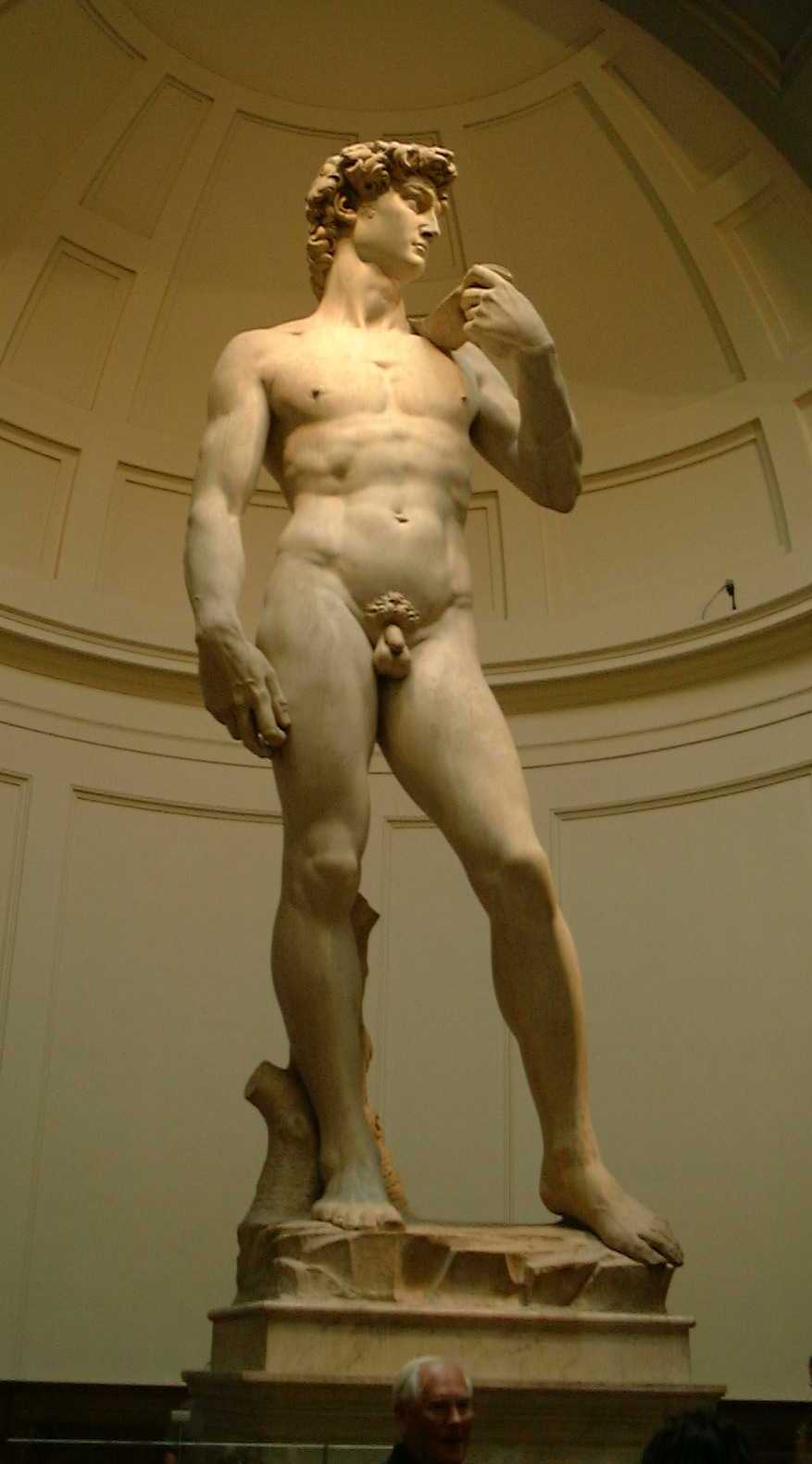
Then again, when I was faced with Michaelangelo's David (and listen: photographs will never express this work), not a force in the world could have convinced me it wasn't the result of genius.
Not even John McClane killing a helicopter with a car.
So my overall opinion is this: The magic of the original Die Hard had a lot to do with where the star was at that point in his career (spunky with something to prove, because he was an acknowledged television star but not by any means celebrated) and where the director was coming from (John McTeirnan tells us on the commentary that he wanted to find the joy in this otherwise harrowing tale). There's a synergy to it that came from taking risks and improvising, something that could never hope to be duplicated in a sequel. When A Streetcar Named Desire was brought to film, it brought together the Stanley from the Broadway cast and the Blanche from the London cast, and it should have exploded. Brash, method Brando set off against Lady Olivier (Vivien Leigh) seems a formula for an insane working environment. Yet it worked beautifully, and it never would have happened if the rules had been followed or sense had prevailed.
Whether it really exists or not, the creative person needs to believe in genius. Maybe, in looking back on a creation, we can readily name its sources and the whole thing seems like a masterminded manipulation of common elements. Yet the feeling of creating something good, of being in a creative spirit, isn't like that. It's a chartless territory, a blank page or a silent room. People often ask authors where they get their ideas from, and it's easy to say, "Oh, I was a closeted homosexual who grew up in the south, so . . . you know . . . ." I believe that it's belief that ideas come from. Creativity springs from a confrontation of nothingness with faith in that intangible genius that we can never prove, but that always intervenes.
Tuesday, June 5, 2007
Women of New York: Kindly Knock It Off.

Friday, March 9, 2007
Don't Lie to Your Mind. It's Unkind.

Yet we all do it. Why? Why should it be so difficult to resist deceiving ourselves? I suppose it has something to do with hope. We need a certain instinct for imaginative creation just to get by, to hypothesize and perceive long-term rewards. This is part of what helped us as a species get to where we are today, the ability to imagine ourselves happier if:
- We kill a mastodon instead of a grass rat;
- We take a little longer to find a sharper rock to skin it with; and
- We avoid killing Ghlugg every time he does that stupid interpretive dance thing.
And relatively speaking (or writing), as long as your hope-o-meter (or fiction-o-gramme, for you Europeans) is in fairly regular interaction with the outside world, you get helpful feedback. Helpful in the sense of:
- Hey! You are a little more awesome than that. Don't dress so poorly.
- Hey! That may look an awful lot like a good thing to eat, but those in the know know it will eventually kill you.
- Hey! You can not fly, no matter how much you want to. Step away from the ledge. Step away . . .
Don't worry guys: I'm only bringing this up because of the title of the play I'm working on now. Yep. And yes, sometimes there is a strange, coincidental reflection between the show one is working on and one's own life. But that's just superstition. And yeah, fate does make fools of us all, and the Oracle can not be broken, and all that, but I'm sure my life is going to be just peachy no matter what portents come my way. And--though this may seem something of a non-sequitor--someday I'll be Batman. Yep. Uh-huh . . .
Wednesday, January 24, 2007
Laughing in the Face of [BLANK]

So I have this theory. Well, I can't actually claim the theory for myself. Neither can I cite it specifically. I think I either read it in college or heard somebody espouse it on The Actor's Studio. Or I made it up, but I doubt that. So I subscribe to this theory, and "this theory" is thus:
Laughter--and its shy cousin, smiling--comes from a sublimated fear reaction. In the process of our intellectual development, an aspect of our fight-or-flight instinct evolved into an instrument that responds not only to immediate environmental threats, but to words and ideas, and in which we have learned to take pleasure.
The theory kind of hinges on the idea that most, if not all, of what we regard as "emotions" evolved from survival instincts. Ergo, the theory relies on you, dear reader, not being an adamant Creationist. So all adamant Creationists, please leave the room now. Go ahead; go. It's okay. We're not excluding you, we're just being considerate of your feelings and your God(s). We'll call you in again when we're back to discussing Kinko's and comic book characters.
...Are they gone? Thank God. Now we can start throwing feces at each other again.
I believe there's something to evolution. You got me there. I recognize it still as being a theory, yes, but it's a sound one in my opinion, and getting sounder all the time (like Radiohead). Me, I think if God is responsible for Creation, s/he/it is a pretty smart cookie and wanted to watch some changes over time. Like Sea Monkeys. And anyway, that's the beauty of a "theory" by the scientific definition. It's useful until it's contradicted by something better.
So: Laughter. Most studies into it, behaviorally speaking, find a strong connection between the response and being in a "play" environment. That goes for man and ape. For apes, "laughter" is more like a kind of involuntary heavy, rapid breathing. Tracing laughter through other animals is more speculative, because, well...they're other animals. Rats, for example, exhibit a behavior that might be laughter: a kind of high-pitched, rapid squeaking. But it might be that all rats share a predilection for singing Prince { O(+> } songs at karaoke. Hard to say. Hyenas are well-documented as laughers, but it doesn't accompany their play. Rather, it accompanies the threat of a food source being taken away from them, so many argue that this isn't laughter per se.
Au contraire, say I, in my snootiest French accent. I consider the definition of laughter, as science would have it, as being a bit too narrow. (That's the way it is with science--one day your friend, the next your nemesis.) Combine it with the feature of the smile (which seems a pretty acceptable association to me) and you've got more to consider as to its origins and relationship to our environment. Specifically, when else do we bare our teeth? When we are threatened.
Apes do this as well. Just about any animal that is willing to bite its way out of a problem will bare its teeth in a social interaction in which violence is imminent. In just such situations, the pulse quickens and the breathing becomes quicker and deeper. Tension mounts, and in an instant is released in one of two directions: fight, or flight. Moreover, there is one overriding fear that dictates this response. It comes with an awareness of the possibility of death.
We have to laugh in the face of death. It is the ultimate ungovernable aspect of our lives, and what else can we do with it? Religion provides answers to our minds, and hopefully our hearts, yet our bodies are still somehow aware of death's finality. And we don't get to face death in absolute scenarios anymore. Even our soldiers tend to be fighting amidst chaos and invisible forces of annihilation, such as falling bombs and super-sonic bullets. Without the possibility of high-stake, fight-or-flight scenarios, a peculiar catharsis is missing from our lives. It's provided for by comedy.
I'm losing some of you, I realize. Sure, there's plenty that we laugh at that has nothing to do with the threat of death. Puns, for example. (Though some are truly deadly.) Also, funny faces, or cartoons.
There will I ask you to hold the phone. Please: hold this phone. Thank you.
Perhaps you can understand the connection between a fear of death and watching a Buster Keaton pratfall. We vicariously experience the possibility of finality when Keaton falls two stories. Maybe it’s only subconsciously. Maybe the pratfall is just a trip. The point is that it introduces a moment of uncertainty into our assumptions, and the mother of all uncertainties, or unknowns, is The Great Beyond. Cartoons continue in this tradition, making the stakes two-dimensional (in most cases) but the threat astronomical. But what of someone making a funny face? Still the unknown, I argue. The more unidentifiable or unexpected the face is, the better the laugh. Because for a moment, we don’t understand. There’s that taste of death, the “little death” of French fame.
I have no explanation for puns.
We don’t laugh only because of fear, but I’m certain it plays a larger role than is immediately apparent. Certainly accessing this fear is the most direct way to make people laugh. The laughter that arises from tickling, or from just enjoying being with someone, that might have other explanations. Then again, tickling takes control of our body away from us; a singularly unnerving experience, that requires one to acknowledge that he or she isn’t absolute. And good friends? Avoiding shock humor, or pratfalls, and still yucking it up? It’s play. It’s why we play games, intentionally and unintentionally. Games simulate the need to make decisions. The tiny or grand oscillations we make toward and away from people, even with people we have no conscious desire to ever be apart from, are tests of our connection: to others, to ourselves, to the world at large. The stakes are there. We are playing with death.
There you have it. Jeff explains it all. No applause, please; just throw money. And hey, disagree with me! I’d love to argue this out. Though I should warn you:
I may just laugh it off.
Thursday, January 11, 2007
WHO'S WITH ME?

A Guy I used to know (and I don't mean Jesus by my all-caps action; his name was actually "Guy [pronounced like 'dye,' not 'dee']" had this character he would pull out on occasion, named Philo [pronounced "Fie-low"][sp?]. Philo was famous for boisterously proclaiming inanities and absurdities, usually of the fairly offensive variety, and then seeking consensus from the room. Usually the room was full of strangers, and usually Philo received little-to-no seconds of his motions. I.e.:
"I say, cute as they may be, baby seals were put on this earth for our carnal pleasure, and, ultimately, for us to club to death. WHO'S WITH ME?!"That was the format. "I say, [insert shocking statement here]. WHO'S WITH ME?!" But don't get the wrong impression about Philo. I rather loathe discomfort humor (Ali G. et al, shock-jokes, etc.) but found Philo hysterical, mostly because he was so impotent. There was no fear of him fulfilling any of his plans, or investing in diabolical real estate (Evil Mastermind Headquarters, for example) unless someone--just once--would back him up. He just made these shocking proclamations and stood there, expectantly looking around him for raised hands.
Well, I have since adopted the jokes for those moments in my life that need levity. It breaks tension well. Just recently, however, I have discovered that more and more I might be just a little Philo. I might be suffering from a mild form of Philo-itis. Hence the subject of today's entry, kiddies:
I sure wish I could stop checking out the ass of every woman I notice.
WHO'S WITH ME?!
...
Oh. Okay. Fair enough. But my point is: I want to stop. This is exactly the kind of behaviour I dislike in "men." When I catch my dad at such antics (or, really, anything that indicates he still has blood flow from the navel down) I think, "Don't be that guy, dude. Don't be that guy." It's gotten astonishingly automatic, though. I am beginning to wonder if ending this behaviour is actually an option for me. And not just because I feel helpless against my primal urges (though I rather do and am), but because those urges have been so neatly integrated into my supposedly more sublime aspirations.
Witness this morning. After more video editing (thank God for removable hard drives) and on my way in to work, coffee in hand, I did me espy a woman crossing Park Avenue with a child who was presumably her own. She was not too terribly New York; active and vibrant, but not dressed to the nines, made-up prettily, but not beyond a comfortable degree. Maybe mid-thirties (alright: "thirtysomething"), and there was something about her smile, her interaction with the child and traffic that made me think to myself, "I'll bet she's making someone very happy."
WHEREUPON I PROMPTLY CHECKED OUT HER ASS.
(It was nice enough. The jeans obscured detailed observation, but seemed well supported by a reasonably firm, round infrastructure.)
WHAT the HELL? Am I doomed to emulate the fourteen-year-olds I'm presently teaching? Shall I revert to finding something entertaining just because it's crudely put? Will I forever be a hunter-gatherer of the junk to be found in trunks? And can Batman and Robin possibly escape the umbrella factory alive?
The answer to all of the above is probably: Yes. It's useless to fight primal urges, expending energy that would be better used to focus those appetites toward valuable ambitions, like learning how to decoupage. Which is to say, the primal urges fuel all our endeavors, even those that end up approaching the sublime (though I can't quite bring myself to categorize decoupage as sublime--such artistic snobbery on my part). I say we just accept it, all we guileless guys who have a conscience about this sort of thing, and just try to be as subtle as possible about it.
WHO'S WITH ME?!